InsertAnywhere: Geometrically Grounded and Optics-Aware Video Object Insertion

ECCV 2026
† equal contribution
1KAIST AI    2SK Telecom
KAIST AI Logo SKT Logo
🧙‍♀️ Wicked
🪄 Harry Potter
💋 Mean Girls
Louis Vuitton Bag in Wicked
Chanel Ballerina Flats in Wicked
Woody in Harry Potter
Books in Harry Potter
Doritos in Mean Girls
Mug in Mean Girls

Abstract

Recent advances in diffusion models have enabled impressive video editing capabilities, yet production-grade Video Object Insertion (VOI) remains challenging due to inadequate 4D scene understanding and a lack of proper optical interactions, such as shadows and reflections. To address these limitations, we present InsertAnywhere, a comprehensive VOI framework that achieves geometrically grounded object placement and optics-aware video synthesis. Our approach first leverages a 4D-aware mask generation module that allows users to anchor an object's 3D pose in a single frame. The framework automatically propagates this placement across the video, accurately handling local scene dynamics and occlusions. To synthesize realistic physical lighting interactions, we introduce Optics-Aware Representation Alignment, a novel strategy that utilizes an extended mask to guide feature extraction, enabling optical effects to seamlessly extend beyond the inserted object's boundary. Finally, to overcome the lack of training data for such phenomena, we construct and open-source ROSE++, a specialized quadruplet dataset tailored for the supervised learning of optical effects. Extensive experiments demonstrate that InsertAnywhere produces geometrically plausible and photometrically realistic insertions in complex real-world scenarios, significantly outperforming existing research and commercial generative tools.

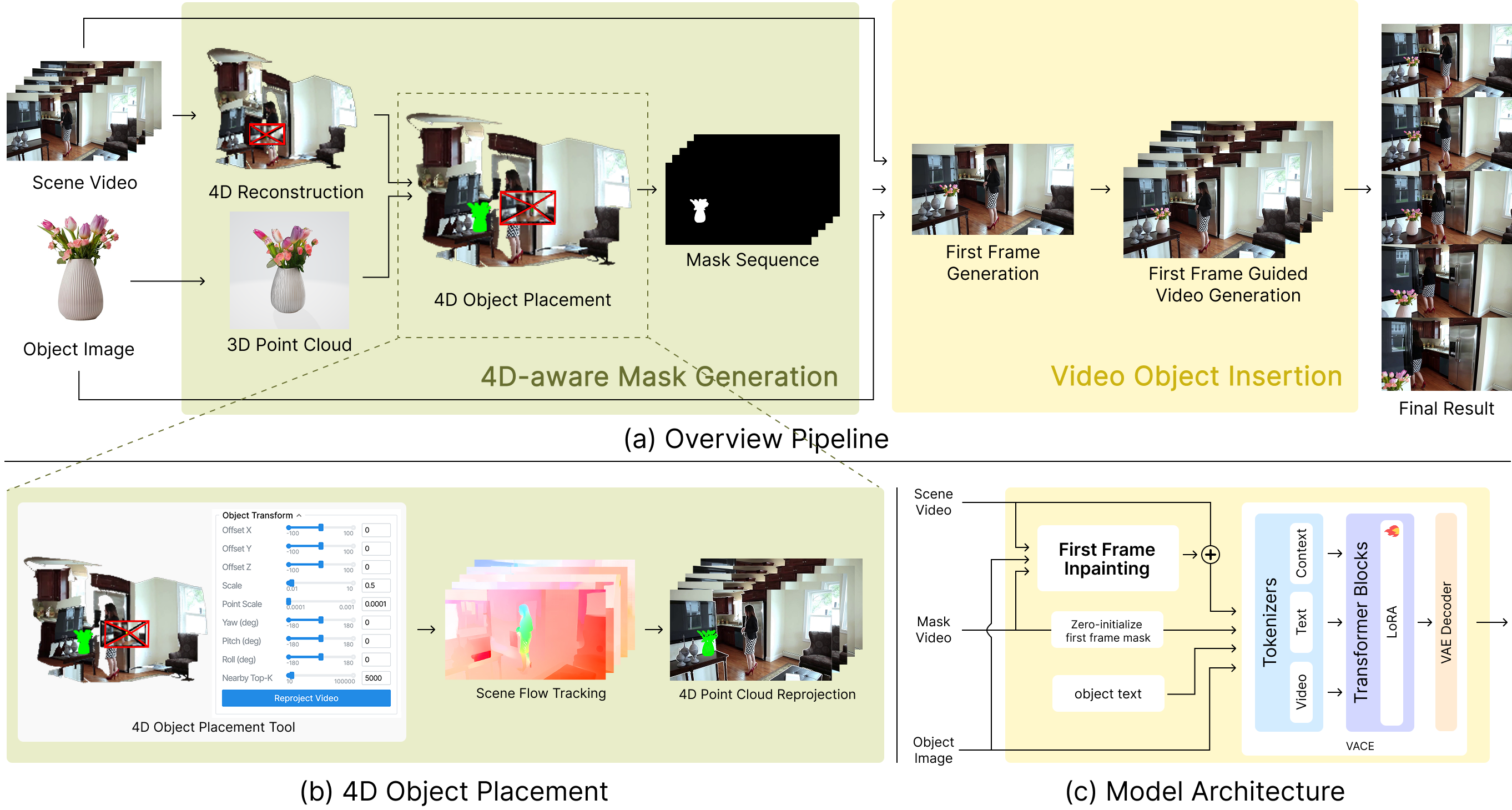
Overall Pipeline

Method overview
4D reconstruction and scene flow propagate a single user-specified 3D placement into a geometrically grounded mask sequence, which then conditions our optics-aware video synthesis.

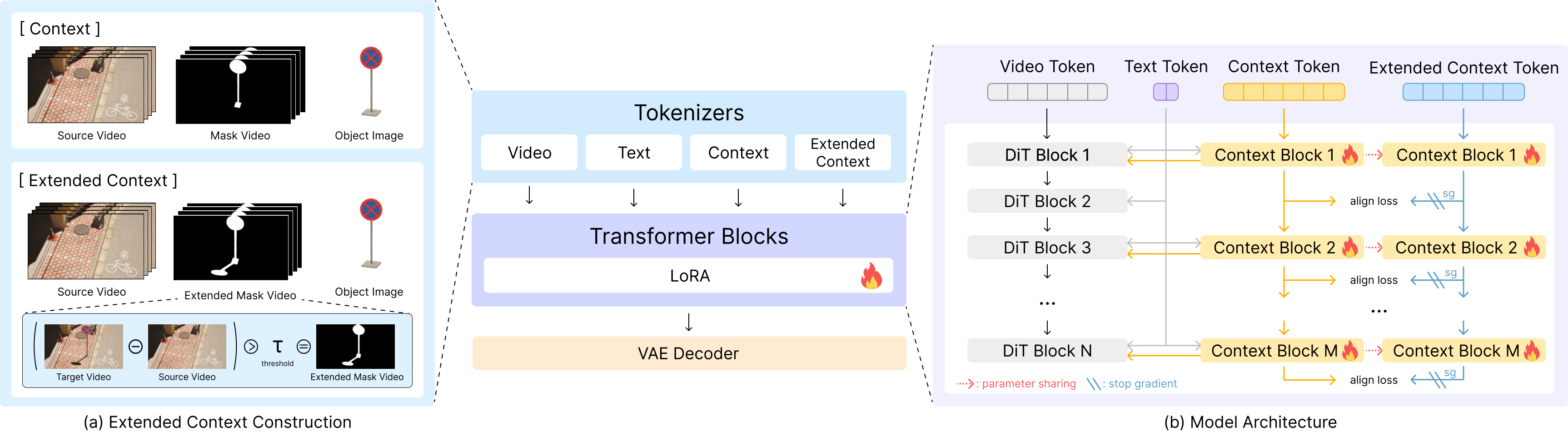
Optics-Aware Representation Alignment

Model architecture
(a) An extended mask, obtained by thresholding target − source, covers the object together with the optical effects it casts. (b) An align loss pulls the context representation toward the extended one, letting shadows and reflections extend beyond the object boundary.

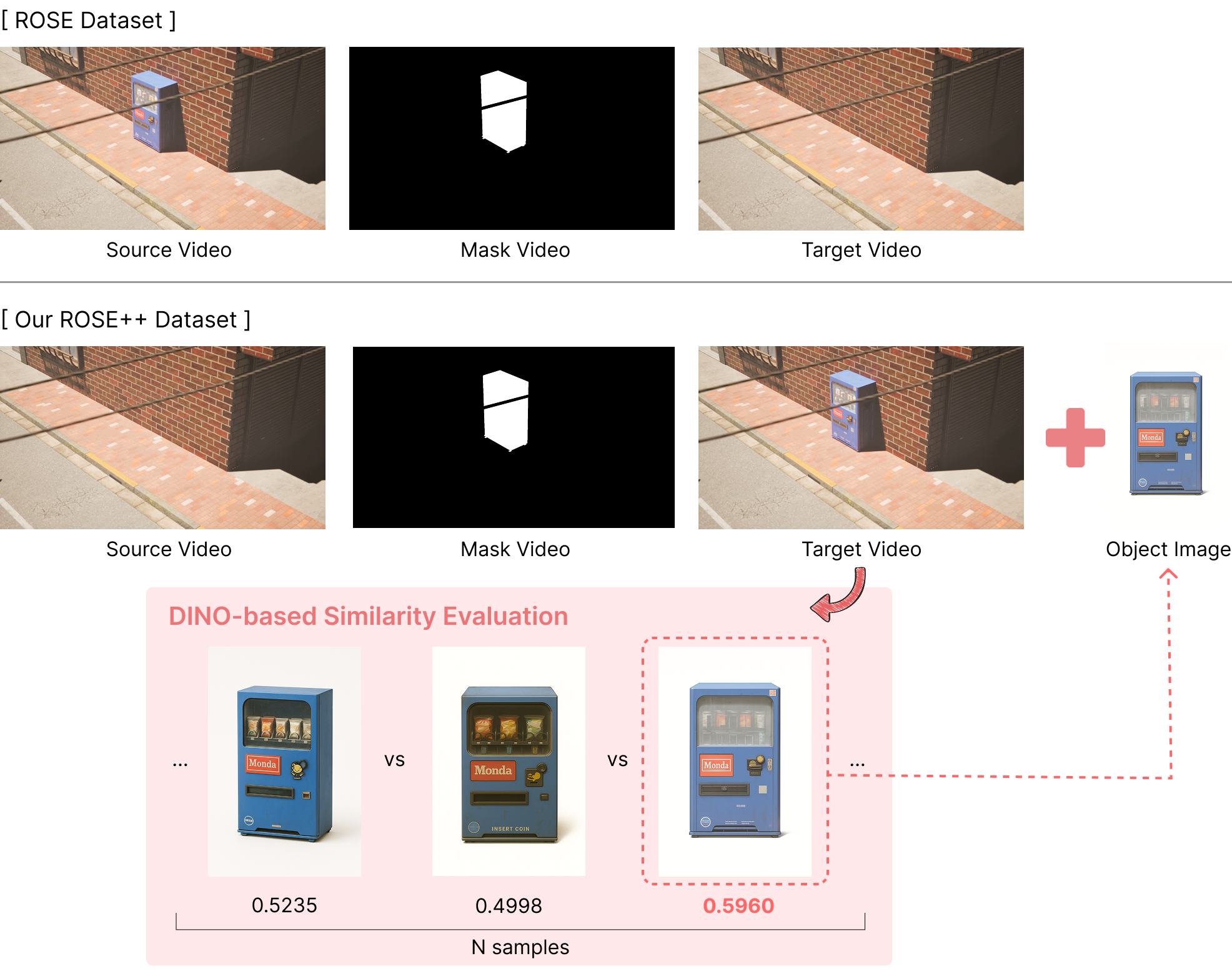
ROSE++ Dataset

Method overview
ROSE++ is a quadruplet dataset built from ROSE — source video, target video, object mask video, and reference image. Reference images are synthesized by an image editing model and filtered by DINO-guided rejection sampling.

Qualitative Comparison

object
Source Pika Pro KlingAI Ours
"Using the context of the video, seamlessly place the image into the empty space of the bed."
object
Source Pika Pro KlingAI Ours
"Using the context of the video, seamlessly place the image into the empty space of the kitchen table."
object
Source Pika Pro KlingAI Ours
"Using the context of the video, seamlessly place the image in front of the left wall."
object
Source Pika Pro KlingAI Ours
"Using the context of the video, seamlessly place the image into the empty space on the table in front of the mirror."

Quantitative Results

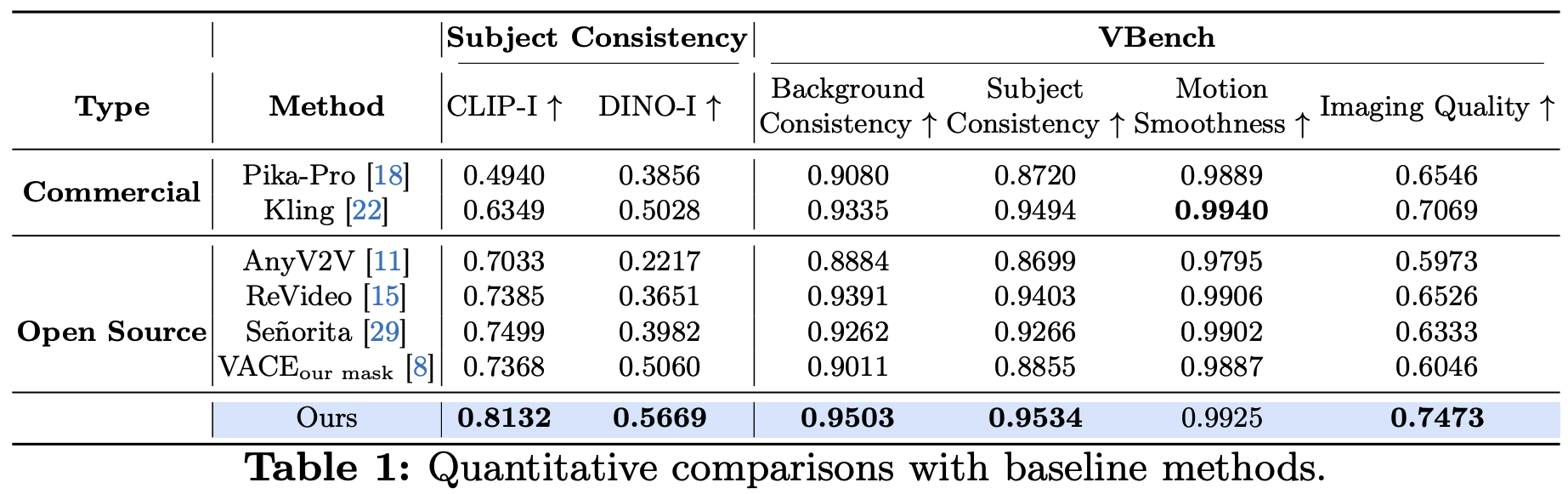
On VOIBench (200 clips), our method outperforms both commercial and open-source baselines on nearly every metric.

Quantitative Results

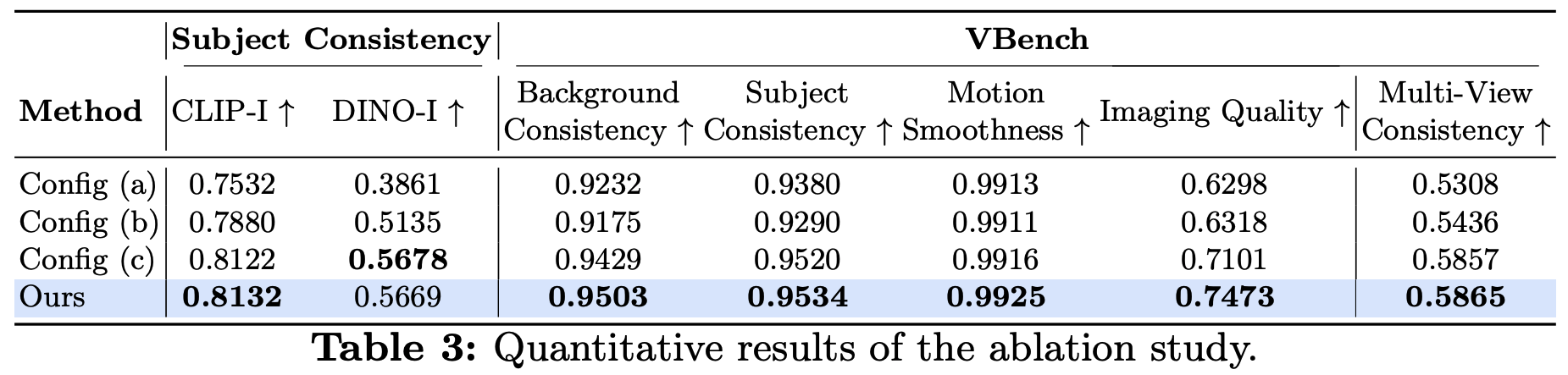
Ablation Study

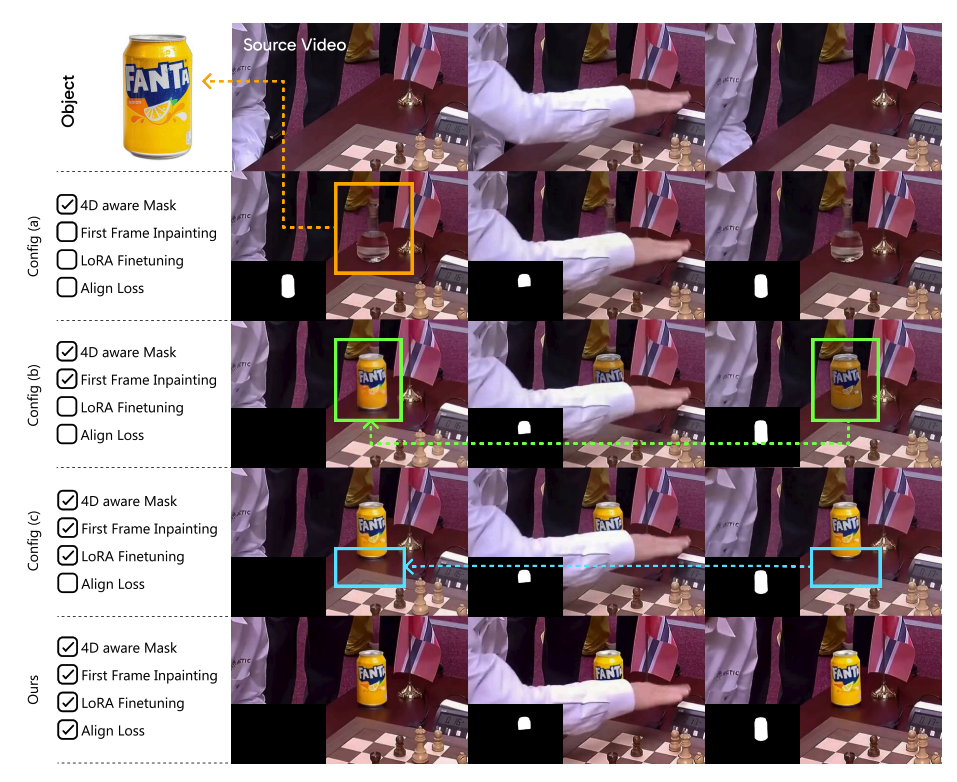
Sequentially adding our components progressively improves occlusion handling, object fidelity, and optics-aware generation.

Ablation qualitative results

Each component contributes, with the align loss giving the largest gain in imaging quality.

Ablation quantitative results

BibTeX

@misc{jin2026insertanywheregeometricallygroundedopticsaware,
      title={InsertAnywhere: Geometrically Grounded and Optics-Aware Video Object Insertion},
      author={Hoiyeong Jin and Hyojin Jang and Junha Hyung and Jeongho Kim and Kinam Kim and Dongjin Kim and Huijin Choi and Hyeonji Kim and Jaegul Choo},
      year={2026},
      eprint={2512.17504},
      archivePrefix={arXiv},
      primaryClass={cs.CV},
      url={https://arxiv.org/abs/2512.17504},
}